How are eco friendly makeup brushes produced in 2026? The answer begins with honest material choices, not attractive green packaging. Manufacturers now examine every component, from the handle and ferrule to the bristle adhesive.
Circular-design expert Dr. Leyla Acaroglu has said, “Sustainability is a design challenge.” Her point fits brush production closely. A genuinely responsible brush needs thoughtful engineering before it reaches a makeup bag.
Many producers select FSC-certified bamboo or responsibly sourced beech for handles. Some use recycled aluminum for ferrules. Others test recycled plastics or bio-based polymers. Each option has weaknesses. Bamboo can absorb moisture without a durable finish. Bio-based materials may still require industrial processing. Recycled aluminum saves resources, but it needs energy to shape.
The bristles often use high-quality synthetic fibers, such as PBT or nylon. These fibers can avoid animal hair and provide consistent softness. However, synthetic does not automatically mean sustainable. The production process, durability, shedding rate, and disposal route still matter.
Factories should reduce water waste during polishing and control solvent emissions. Water-based coatings can offer a safer alternative, when performance testing supports them. Stronger adhesives may extend brush life, but they can complicate recycling. That trade-off deserves attention.
Reliable manufacturers test shedding, odor, handle strength, and repeated washing. They also document supplier origins and labor standards. Certifications help, but they never replace transparent evidence.
This 2026 guide explores how are eco friendly makeup brushes produced, including materials, factory methods, packaging, and end-of-life concerns. The process is improving. It is not perfect yet. That honesty matters.
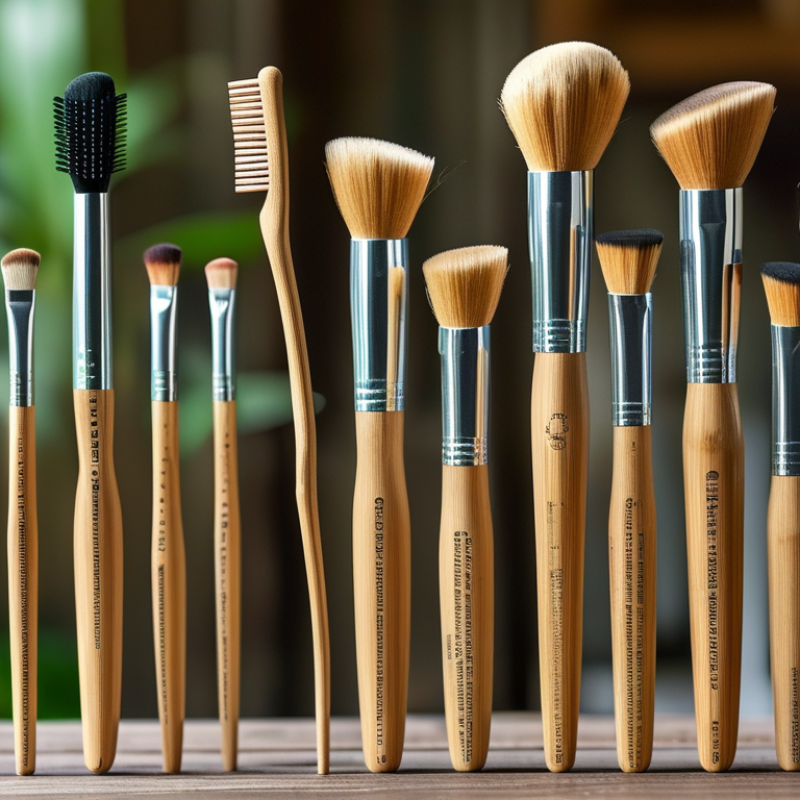
In 2026, an eco-friendly makeup brush should meet a measurable standard, not just carry a green label. The definition starts with its full life cycle: raw materials, manufacturing, use, cleaning, and disposal. A responsible producer should document recycled or renewable content, water use, energy sources, and factory conditions. Claims need evidence from supplier records, independent testing, or recognized certification. Words such as natural and biodegradable are too vague alone. They can mislead shoppers.
Material choices require practical judgment. A handle made from certified wood may reduce fossil inputs, but its coating and adhesive still matter. Recycled aluminum can improve durability when its origin is traceable. Synthetic bristles may avoid animal-derived materials and shed fewer fibers when engineered well. In practical brush evaluations, I inspect softness, pigment pickup, ferrule strength, wash resistance, and shedding after repeated cleaning. A brush that fails quickly creates more waste. Performance is part of sustainability.
Packaging should be minimal, recyclable where local systems accept it, and clearly labeled. Manufacturers should publish repair, replacement, and disposal guidance. Yet no single material wins every comparison. We still need better data on mixed-material brushes and adhesive separation. That gap deserves honest disclosure. The strongest 2026 standard may be demanding but flexible: measurable inputs, safe production, long service life, and transparent limits. Perfection is unlikely. Continuous review is essential.
Recycled-content certification provides a measurable starting point for evaluating eco-friendly makeup brush components. The Recycled Claim Standard (RCS) requires at least 5% recycled material, while the Global Recycled Standard (GRS) requires at least 20%. FSC Recycled products must contain 100% recycled wood or paper-based material. These thresholds apply to certification requirements and should be assessed together with durability, responsible packaging, chemical safety, and end-of-life design.
Sources: Textile Exchange RCS, Textile Exchange GRS, Forest Stewardship Council
Choosing materials for an eco-friendly makeup brush starts with the bristles, not the packaging. Synthetic filaments made from recycled PET can reduce demand for virgin plastic. However, results depend on collection, washing, and reprocessing quality. Textile Exchange’s 2024 Materials Market Report reports 132 million tonnes of global fiber production in 2023. It projects approximately 160 million tonnes by 2030. Recycled feedstock is valuable, but not automatically sustainable. Bio-based nylon also needs careful review. It may reduce fossil input, yet it is usually not compostable. Test powder pickup, softness, shedding, and cleaning resistance after repeated use. Performance matters. Test twice.
For handles, FSC-certified wood, bamboo, recycled aluminum, and durable bio-based plastics are practical options. Bamboo grows quickly, but coatings, adhesives, and long-distance shipping can weaken its advantage. Recycled aluminum offers strength and easier material recovery. The International Aluminium Institute reports that recycling aluminum uses about 95% less energy than producing primary aluminum. Ferrules should match the handle and bristle requirements. Aluminum suits lightweight designs, while stainless steel can improve rigidity and corrosion resistance. Avoid bonded multilayer parts when possible. They complicate recycling. A production specification should record recycled content, energy sources, water use, adhesive chemistry, and end-of-life options. No material wins everywhere. I would not label a brush sustainable because it contains bamboo alone. Supplier audits, batch testing, and honest lifecycle data matter more than attractive claims.
Producing eco-friendly makeup brushes in 2026 requires more than replacing plastic handles. Designers must reduce waste from material selection through final inspection. A bamboo, recycled aluminum, or certified wood handle can lower impacts, but only when sourcing is traceable. Ask suppliers for origin records, recycled content data, and current safety documentation. The ferrule should resist corrosion and use minimal material. A secure fit also prevents early disposal. From workshop trials, small changes in handle thickness can save material without weakening grip. However, every material choice has trade-offs. Bamboo may need coatings, while recycled metals can require energy-intensive processing.
Tips: Build a simple material scorecard before production. Measure renewable content, recycled content, transport distance, durability, and end-of-life options. Test shedding, odor, handle strength, and cleaning resistance in controlled batches. Keep failed samples; they reveal design weaknesses. Use water-based finishes where performance permits, and design parts for easier separation. Packaging should fit the brush closely, using recycled paper inserts instead of oversized plastic trays. Do not claim “zero waste” unless measured.
Efficient production depends on clear work instructions and careful process checks. Cutting plans can reduce offcuts, while modular components simplify repairs. Workers should record defects by type, not merely count rejected units. This creates evidence for corrective action. Independent testing can strengthen reliability, especially for skin-contact materials. Yet sustainable design is never finished. A thinner handle may break during shipping. A biodegradable component may fail after repeated washing. Review customer returns, factory data, and supplier changes each season. Improve the design honestly, even when the result looks less impressive on paper.
Producing eco-friendly makeup brushes begins with material choices and measurable controls. A responsible factory may use certified wood, recycled aluminum ferrules, and synthetic fibers designed for long service. Natural fibers are not automatically sustainable. Their farming, processing, and animal-welfare impacts require careful verification. Suppliers should provide origin records, chemical disclosures, and consistent batch information. Measure it. Keep records.
During manufacturing, machines should use efficient motors, dust extraction, and controlled water systems. Wood components need accurate shaping to reduce offcuts. Rejected parts should be separated for reuse or recycling where facilities allow. Workers also need safe ventilation, protective equipment, and practical training. These details affect quality and ethics together. An experienced production team tests fiber shedding, ferrule pull strength, handle durability, and repeated washing before approving a batch.
Assembly requires controlled adhesive application, clean workstations, and enough curing time. Rushing this stage can cause loose ferrules or unpleasant odors. Finishing teams should sand handles smoothly, apply lower-impact coatings, and inspect every brush under clear lighting. Packaging can use minimal paperboard and avoid unnecessary inserts. Still, no brush is impact-free. Recycled materials may have supply limits, and water-based finishes can be less resistant in some conditions. Manufacturers should report these trade-offs honestly instead of making broad green claims. Small imperfections in early production reviews can reveal larger process problems, so feedback should change the next batch.
How to Produce Eco Friendly Makeup Brushes in 2026?
Sustainable makeup brushes need evidence, not only attractive claims. A practical test plan should measure bristle shedding, handle strength, ferrule pull resistance, and repeated washing. Brushes should survive realistic use, including wet hands, warm water, and daily cleaning. Inspectors can record broken fibers after 30 or more wash cycles. Skin-contact materials also need safety screening for restricted substances and irritating residues. Testing should follow recognized laboratory methods, with samples taken from different production batches.
Packaging deserves the same attention. Choose recycled paper, responsibly sourced cardboard, or molded fiber with clear material separation. Avoid oversized boxes, unnecessary plastic windows, and mixed layers that local facilities cannot process. Test the package for compression, humidity, and drop resistance. A damaged brush creates more waste than a slightly heavier box. Our first packaging idea looked sustainable but failed during shipping. That mistake was useful.
Certification can make claims more reliable, but its scope matters. A paper certificate may cover the packaging, not the brush handle or bristles. Check whether certification verifies recycled content, responsible forestry, chemical management, or factory systems. Keep supplier declarations, batch records, laboratory reports, and audit dates together. Independent verification is stronger than a website promise. No material is perfect. Sustainable production still requires honest trade-offs, regular retesting, and willingness to revise weak decisions.
| Production Area | Sustainability Dimension | Recommended Material or Requirement | Test or Verification Method | Practical 2026 Target | Relevant Certification or Standard |
|---|---|---|---|---|---|
| Handle | Renewable material sourcing | Bamboo or other rapidly renewable wood from a documented, legal source; use water-based coating where technically suitable. | Supplier traceability review, moisture inspection, coating adhesion test, and restricted-substance screening. | 100% of wooden or bamboo content traceable to the material source; no visible cracking, splintering, or coating delamination after conditioning. | FSC or PEFC chain-of-custody documentation where applicable; ISO 14021 for carefully substantiated environmental claims. |
| Ferrule | Recycled metal content and recyclability | Aluminum or stainless steel with a declared recycled-content percentage; avoid unnecessary mixed-material laminates. | Material declaration, mass-balance calculation, corrosion testing, and pull-off strength testing. | Declare the actual recycled content by mass; ferrule remains securely attached after repeated wet and dry handling. | GRS or equivalent recycled-content verification when the required input and chain-of-custody conditions are met. |
| Bristles | Animal-free fiber selection | Synthetic PBT, PET, or nylon fibers with documented polymer composition; specify the colorant and finishing chemistry. | Fiber identification by supplier documentation or laboratory spectroscopy; visual uniformity and shedding inspection. | No animal-derived fiber; fiber type and additives disclosed in the technical file. | Use an animal-free claim only when supported by material records and a documented supply-chain review. |
| Bristle performance | Durability and product lifetime | Use a defined bristle diameter, crimp, tip finish, and adhesive system appropriate to the brush function. | Bristle-shedding count, flex recovery, dry-use simulation, wet-use simulation, and repeated washing test. | Set an internal acceptance limit for shedding and require no structural failure after the intended cleaning-cycle simulation. | Documented internal product specification; test conditions should be retained for batch comparison. |
| Chemical safety | Restricted substances and user contact safety | Control heavy metals, formaldehyde, aromatic amines, phthalates, PFAS where relevant, and other substances restricted by the destination market. | Risk-based laboratory screening of fibers, coatings, adhesives, dyes, and printed components. | All tested substances meet the applicable legal limits for each sales market, with current laboratory reports. | Apply destination-market chemical legislation and a documented restricted-substance list; do not rely on a sustainability label alone. |
| Manufacturing | Energy and water efficiency | Measure electricity, fuel, process water, wastewater, and production yield by batch or defined reporting period. | Utility-meter review, production-record reconciliation, and waste-stream measurement. | Establish a 2026 baseline and report energy, water, and scrap intensity per 1,000 finished brushes. | ISO 14001 may support an environmental-management system; measured reductions must be reported separately from certification status. |
| Carbon accounting | Product greenhouse-gas footprint | Include raw materials, manufacturing energy, packaging, transport assumptions, and end-of-life boundaries. | Life-cycle assessment or product carbon-footprint calculation using documented activity data and emission factors. | Publish the functional unit, system boundary, data year, assumptions, and whether offsets are excluded or reported separately. | ISO 14067 for product carbon footprints; ISO 14040 and ISO 14044 for life-cycle assessment principles and framework. |
| Primary packaging | Material reduction and recyclability | Use appropriately sized paperboard or molded fiber packaging; eliminate plastic windows, magnets, and unnecessary inserts where feasible. | Packaging bill-of-materials review, total packaging-weight calculation, and damage-rate monitoring. | Report packaging grams per brush and ensure all components have clear disposal instructions for the target market. | FSC or PEFC documentation for certified paper fibers; use recyclability claims only where local collection and sorting support them. |
| Packaging inks and coatings | Recycling compatibility | Prefer low-migration, water-based inks and coatings compatible with the selected paper-recycling route. | Supplier technical declaration, print-quality inspection, and packaging-recycling compatibility review. | Avoid plastic lamination unless required for product protection; disclose any coating that may affect disposal. | Use substantiated, market-specific recycling guidance rather than a universal “recyclable” statement. |
| Transport packaging | Logistics efficiency | Use right-sized corrugated cartons, recycled paper cushioning, and stable pallet configurations. | Carton compression, vibration, drop, and transit-damage testing appropriate to the distribution route. | Track void-fill ratio, shipment damage rate, packaging weight, and load utilization by transport mode. | Use recognized packaging and transport test procedures selected according to package size, weight, and route risk. |
| Compostability claims | End-of-life accuracy | Do not describe a complete brush as compostable unless every relevant component and the applicable disposal system have been assessed. | Material-specific biodegradation, disintegration, ecotoxicity, and heavy-metal testing where a compostability claim is proposed. | State “industrial compostable” only when the product meets the applicable specification and suitable facilities exist in the intended market. | EN 13432 or ASTM D6400 may apply to qualifying compostable packaging; certification scope must match the exact product or component. |
| Environmental claims | Evidence and claim transparency | Define each claim precisely, including percentage, component, geographic scope, reporting period, and disposal conditions. | Technical-file audit, supplier-document review, and independent verification for high-risk or comparative claims. | Maintain evidence before publishing claims such as “recycled,” “plastic-free,” “carbon neutral,” or “biodegradable.” | ISO 14021 provides principles for self-declared environmental claims; follow applicable consumer-protection rules in each market. |
| Quality management | Consistency and corrective action | Use approved material specifications, batch records, inspection plans, and a process for handling nonconforming products. | Incoming inspection, in-process checks, final sampling, complaint analysis, and corrective-action records. | Retain test reports and traceability records for each production batch and review sustainability indicators at defined intervals. | ISO 9001 can support a quality-management framework; certification is not proof that a product is sustainable. |
Note: Targets are product-development benchmarks. Certification eligibility, test limits, and environmental claims must be confirmed against the current requirements of the destination market and the exact product configuration.
It should have measurable environmental information across its full life cycle. This includes materials, manufacturing, use, cleaning, and disposal. Green wording alone is insufficient. Evidence matters.
Certified wood, bamboo, recycled aluminum, and well-designed synthetic bristles may reduce certain impacts. Their origins should be traceable. Coatings, adhesives, energy use, and transport still affect the result. No material wins every comparison.
Create a scorecard covering recycled content, renewable content, transport distance, durability, and disposal options. Request supplier records and safety documents. Test small batches before scaling production. Keep failed samples.
Test softness, pigment pickup, shedding, handle strength, and ferrule resistance. Wash samples repeatedly with warm water and wet hands. Record broken fibers after at least 30 cleaning cycles. Durability is environmental performance.
A brush that breaks quickly becomes waste, even if its materials appear responsible. Check grip strength, corrosion resistance, adhesive stability, and cleaning resistance. A thinner handle may save material but fail during shipping. That trade-off matters.
Use closely fitted recycled paper, responsibly sourced cardboard, or molded fiber. Avoid oversized boxes, plastic windows, and difficult mixed layers. Test packages for drops, humidity, and compression. Our first idea failed shipping tests.
Keep supplier declarations, batch records, laboratory reports, and audit dates together. Independent testing can support claims about materials and safety. Check what a certificate actually covers. A certificate may cover packaging only.
Publish material origins, recycled content, energy sources, water use, factory conditions, and disposal guidance. Explain repair and replacement options. Disclose uncertainty about mixed materials and adhesive separation. Perfection is unlikely.
Producing eco-friendly makeup brushes in 2026 begins with clear environmental and ethical standards covering materials, labor, durability, and end-of-life disposal. The process asks how are eco friendly makeup brushes produced through a complete sustainability plan: selecting renewable, recycled, biodegradable, or responsibly sourced materials for bristles, handles, and ferrules while maintaining softness, strength, hygiene, and performance. Designers also consider efficient shapes, minimal components, repairability, and low-waste manufacturing methods to reduce resource use.
Responsible production continues through careful molding, cutting, assembly, bonding, and finishing processes that limit energy consumption, water waste, and harmful substances. Each brush should be tested for safety, shedding, durability, and function before being packed in recyclable or compostable materials with minimal excess. Where appropriate, transparent certifications and traceable sourcing can help verify environmental claims. Overall, sustainable makeup brushes combine thoughtful design, responsible manufacturing, dependable performance, and packaging choices that reduce their impact throughout the product life cycle.

Exio Beauty