What are the latest trends in beauty tool manufacturing? The answer is showing up in the details: lighter handles, quieter motors, replaceable heads, and clearer instructions. Brands are also exploring skin-sensing features and connected devices. Yet a new feature is not automatically a useful one. It must work consistently, feel comfortable in the hand, and withstand repeated cleaning.
Cosmetic chemist and science educator Dr. Michelle Wong is a relevant voice on evidence-led beauty claims. A responsible editorial paraphrase of that approach—not a verbatim quotation—is: “A beauty tool should earn trust through evidence, not trend claims.” That distinction matters on a factory floor. A sensor may look impressive in a product demo, but teams still need to test its readings across different skin tones and lighting conditions. Small design choices count, too. A slippery grip or a charging port that traps moisture can frustrate users quickly.
This guide explores how to track emerging materials, product features, quality controls, and manufacturing choices. It also asks a less comfortable question: are brands solving real user problems, or adding features because competitors have them? Trends move quickly. Reliable testing, clear performance information, and practical repair options remain worth watching.
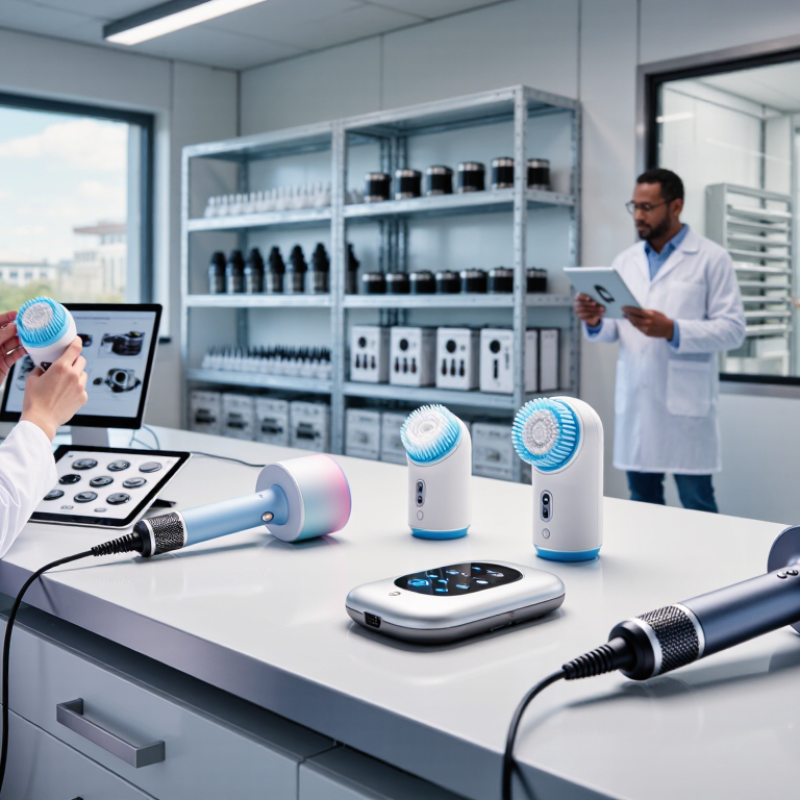
Defining the scope of beauty tool manufacturing trends starts with deciding which products you mean. Include tools such as facial cleansing brushes, hair styling devices, nail care equipment, and reusable applicators. Each category has different materials, production steps, and quality checks. Keep adjacent areas, such as skincare formulas, outside the scope unless they directly affect tool design. Otherwise, research can become unfocused quickly.
Set clear boundaries for time, geography, and evidence. For example, compare manufacturing changes from the past three years within one target market. Track practical indicators: material choices, assembly methods, product testing, packaging, and reported consumer needs. Separate measured information from predictions. Trade reports and manufacturer disclosures can help, but check their dates and methods before relying on them. The boundary is not always neat; a packaging change may influence product design, but it may not represent a manufacturing trend by itself.
Tips: Write down what counts as a trend before collecting examples. Note the source and date beside each claim. If the evidence is thin, say so; a small sample can be misleading.
How to Find the Latest Beauty Tool Manufacturing Trends?
Identify Reliable Industry and Regulatory Information Sources
Trend research for beauty tools is only as sound as its sources. Start with official regulator websites and government gazettes in the markets where a product will be sold. Search notices on materials, electrical safety, labeling, and product claims; requirements vary by tool type and destination. Check publication dates and whether a notice is a proposal, final rule, or guidance. Small distinction. It can change a production plan. Use standards organizations’ catalogs to identify relevant test methods, then confirm current editions with the issuing body. A summary page may omit amendments. Do not rely on an old supplier PDF.
For manufacturing signals, compare established trade publications, technical sessions from industry exhibitions, patent databases, and public filings. Treat exhibitor claims as leads, not proof. Check whether several independent sources point to the same shift, such as lighter materials or easier cleaning. Pair those reports with recall notices and official safety alerts. Keep a simple source log. Record the date, market, source type, and exact claim; this makes conflicting information visible before it enters a forecast. The evidence can be untidy. Trade coverage may lag production, while a patent does not prove commercial adoption. Use both, cautiously.
Use the sources below to track verifiable signals. Regulatory requirements depend on product design, intended use, sales market, and claims; a trend signal is not proof of market-wide adoption.
| Trend or topic to monitor | Reliable information source | What to check | How it informs manufacturing | Suggested review |
|---|---|---|---|---|
| Electrical and heated beauty tools Examples: hair or skin-care appliances |
International Electrotechnical Commission (IEC) standards catalogue: IEC 60335-2-23 search | Applicable safety-standard editions and requirements for appliances for skin or hair care. Confirm the applicable standard for the specific product and market. | Supports design reviews for electrical, thermal, and construction safety. The standard is a reference point, not evidence that a particular product is compliant. | At design gates and when standards are revised. |
| Consumer-product safety and traceability Relevant to tools sold in the European Union |
European Union General Product Safety Regulation, Regulation (EU) 2023/988: Official legal text | Safety obligations, product identification, responsible economic operators, and online-sales provisions. The Regulation has applied since 13 December 2024. | Highlights the importance of product-risk assessment, traceability information, and market-specific documentation in product and packaging workflows. | Before EU market entry and during compliance reviews. |
| Product safety alerts and recurring defects Consumer products in the European Union |
European Commission Safety Gate: Public alert database | Search alerts by product type and hazard, such as electric shock, burns, fire, or chemical risk. Check each alert’s product details and reporting country. | Can help identify hazards to consider in product testing, supplier controls, and corrective-action planning; alerts are not a complete market-failure dataset. | Monthly, and before finalizing risk controls. |
| Recall patterns in the United States Consumer product safety |
U.S. Consumer Product Safety Commission (CPSC): Recall database | Recall notices, stated hazards, affected product characteristics, and corrective actions for relevant product categories. | Provides real-world examples for hazard reviews and quality-control checks. A recall notice does not by itself establish a trend across the whole industry. | Monthly or during product-risk reviews. |
| Patent activity and emerging product concepts | World Intellectual Property Organization (WIPO) PATENTSCOPE: Patent search | Search patent records using terms for beauty tools, components, functions, and materials; review publication dates, classifications, and jurisdictions. | Can reveal areas of technical activity, such as device functions or applicator designs. Patent filings do not prove commercial launch, demand, or freedom to operate. | Quarterly, using consistent search terms. |
| Cosmetic manufacturing practices for bundled products Relevant when a tool is sold with a cosmetic product |
International Organization for Standardization (ISO), ISO 22716:2007: Cosmetics — Good Manufacturing Practices | The standard’s scope and current status. It addresses good manufacturing practices for cosmetic products, not the general manufacture of beauty tools. | Useful for understanding quality-system expectations for cosmetic products packaged with tools; keep tool and cosmetic-product compliance assessments distinct. | When designing bundles or reviewing cosmetic-product suppliers. |
| Cosmetics regulatory changes Relevant to cosmetic products, not automatically to the tools themselves |
U.S. Food and Drug Administration (FDA), Modernization of Cosmetics Regulation Act (MoCRA): FDA MoCRA information | Cosmetic facility registration, product listing, safety substantiation, and other applicable obligations. Check current FDA guidance and exemptions. | Important when manufacturing or distributing cosmetics alongside a beauty tool. Do not treat MoCRA as a general device-registration rule for standalone tools. | At product launch and whenever FDA guidance changes. |
| Medical-device pathway for tools with medical intended uses | FDA 510(k) Premarket Notification database: FDA 510(k) database | Search relevant device types and indications when a product’s intended use or claims may place it within medical-device regulation. Classification depends on the product and claims. | Helps distinguish ordinary beauty tools from products that may require a medical-device regulatory pathway. A database search is not a substitute for regulatory assessment. | Before making medical claims or entering a regulated device market. |
| Import and export signals Trade data for relevant product categories |
U.S. International Trade Commission (USITC) DataWeb: Trade data portal | Import and export values or quantities by selected tariff classification, trading partner, and period. Product classification may vary; validate codes with a customs specialist. | Offers trade-flow context, but classifications may combine products and do not directly measure retail demand or manufacturing output. | Quarterly, comparing consistent classifications and periods. |
Beauty tool trends often begin with material changes. Manufacturers are testing recycled plastics, stainless steel, soft-touch silicone, and plant-based composites. The label alone proves little. Ask for material specifications, supplier documentation, and samples that show color consistency, surface finish, and wear after repeated cleaning.
Small details matter. A handle that feels balanced during a short demo may become tiring after ten minutes. Compare prototypes under realistic use, and record grip comfort, heat transfer, and cleaning time. Emerging production technologies can help: 3D printing supports rapid shape trials, while machine vision can spot uneven seams or coating defects. These methods may reduce rework, but they need skilled operators and regular calibration.
Watch how factories change the process, not just the product. Automated assembly can improve repeatability, while modular tooling may make small design adjustments faster. Request process records, defect rates, and test results across more than one production batch. Not every upgrade works. A newer coating may scratch sooner than an established finish, and recycled inputs can vary between shipments. That takes time. Compare findings over several months, and note where evidence is still incomplete.
Track emerging materials, technologies, and production methods. Global industrial robot installations offer a useful indicator of automation trends that may inform beauty-tool manufacturing.
Annual industrial robot installations worldwide, in thousands of units. This is an industry-wide automation indicator, not beauty-tool-specific data. Source: International Federation of Robotics (IFR), World Robotics.
How to Find the Latest Beauty Tool Manufacturing Trends?
Verify Trends Through Market Data and Expert Insights
A popular product on social media is not automatically a manufacturing trend. Check whether interest appears across several sources, such as retailer listings, search data, trade surveys, and public company reports. Look for changes over time, not a single spike. Numbers can mislead. Seasonal promotions or viral videos may briefly inflate demand without showing lasting production needs.
Compare those signals with conversations from product engineers, factory quality specialists, and materials experts. Ask specific questions: Are more buyers requesting rechargeable designs? Are suppliers seeing demand for smaller production runs or easier-to-clean surfaces? Experts can explain why a pattern is emerging, but their experience may reflect only one market or customer group. Ask what evidence supports their view, and where it might not apply.
Keep a simple evidence log. Record the source, publication date, region, and measurement behind each claim. Then compare the claim with real product details, such as motor type, battery capacity, packaging, or cleaning instructions. A discrepancy is useful. For example, rising search interest paired with unchanged retailer inventory may signal curiosity, not broad adoption. Research is rarely tidy; I would treat an early conclusion as provisional and revisit it when fresher data becomes available.
A new beauty-tool trend is useful only when it solves a real customer problem. Before investing in a feature, compare it with customer reviews, support requests, and product-return reasons. If users repeatedly mention awkward grips or difficult cleaning, those needs may matter more than a clever new finish. That matters.
Check whether the trend fits your manufacturing capabilities. A quieter motor, replaceable head, or textured handle can affect materials, assembly time, and quality checks. Ask suppliers for sample units and inspect them under ordinary conditions: wet hands, a crowded bathroom shelf, or repeated daily use. A polished prototype can hide inconvenient details.
Small tests help separate interest from lasting demand. Offer a limited run or gather feedback from a representative group, then track comfort, durability, and ease of cleaning. Look for patterns, not one enthusiastic comment. I have seen teams overvalue novelty and overlook how a tool feels after several weeks. That judgment can be wrong, too. Compare customer evidence with production costs and realistic performance targets before changing a design. A trend may suit one customer group but frustrate another, especially when routines and preferences differ. Test before scaling.
Manufacturers are testing recycled plastics, stainless steel, soft-touch silicone, and plant-based composites. Ask for specifications and samples.
Clean samples repeatedly and inspect color, surface finish, and wear. A label alone proves little.
Use it for more than a quick demonstration. Check grip comfort, heat transfer, and cleaning time.
3D printing helps test shapes quickly. Machine vision can detect uneven seams or coating defects, but needs calibration.
No. A new coating may scratch sooner, and recycled materials can vary between shipments. Check multiple production batches.
Compare retailer listings, search data, trade surveys, and public reports over time. Numbers can mislead.
Ask about buyer requests, such as rechargeable designs or smaller production runs. Also ask what evidence supports their view.
Record each source, date, region, and measurement. Compare claims with product details, such as battery capacity or cleaning instructions.
Keep them provisional and revisit them with newer data. Research is rarely tidy.
Finding the latest beauty tool manufacturing trends begins with defining the scope of your research. Decide which product categories, production stages, and customer needs matter most to your business. Then consult reliable industry publications, technical research, and relevant regulatory guidance to build a well-rounded picture rather than relying on a single source.
To answer “what are the latest trends in beauty tool manufacturing,” monitor developments in materials, manufacturing technologies, and production methods, and compare them with market data and insights from experienced professionals. Look for evidence that a trend is gaining lasting interest, not just short-term attention. Finally, assess whether each development fits your capabilities, target customers, quality expectations, and business goals. This practical approach helps you distinguish useful opportunities from passing trends and make informed decisions about future products and manufacturing plans.

Exio Beauty